The power system plays a critical role in the operating efficiency, reliability, and maintenance costs of oil drilling rigs.
The mud pump is a core component of the drilling fluid circulation system. Its primary function is to deliver high-pressure drilling fluid downhole. Based on the power transmission method, mud pumps mainly use two drive configurations: Mechanical Drive and Electric Drive.
The key difference between these two systems is how power generated by the diesel engine is transmitted to the mud pump. In a mechanical drive system, engine power is transferred directly through a mechanical transmission system. In an electric drive system, the diesel engine first drives a generator to produce electricity, which is then used to power an electric motor connected to the mud pump.
This article provides a detailed overview of both drive systems, covering power transmission routes, diesel engine models, hydraulic transmission units, and related equipment, with a particular focus on Jichai (JDEC) 190 Series diesel engines.
1. Mechanical Drive: An Important Application of Jichai 190 Series Diesel Engines
1.1 Power Transmission Route of Mechanical Drive Drilling Rigs
A typical mechanical drive system follows this power transmission route:
Diesel Engine → Hydraulic Coupling / Torque Converter → Gearbox → Drive Shaft → Mud Pump
In a mechanical drive drilling rig, the mechanical power generated by the diesel engine is transmitted to the mud pump through hydraulic transmission equipment and a mechanical drivetrain.
After the diesel engine starts, its power passes through a hydraulic coupling or torque converter and then through the corresponding transmission components to the mud pump crankshaft. This drives the reciprocating movement of the pump pistons, generating high-pressure drilling fluid.
It is important to note that not all mechanical drive systems use exactly the same transmission configuration. Some systems use hydraulic couplings, while others use torque converters. Different types of reduction gearboxes or transmission gearboxes may also be installed depending on the equipment design.
1.2 Jichai 190 Series Diesel Engines: An Important Power Source for Mechanical Drilling Rigs
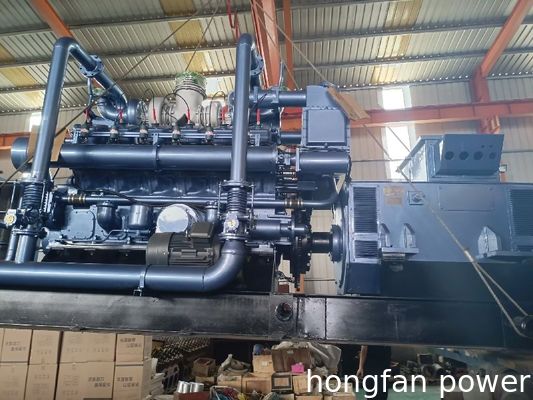
The Jichai 190 Series is one of the representative diesel engine series used in China's oil drilling equipment industry. It mainly includes the 2000 G12V190PZL Series and 3000 Series A12V190PZL H12V190PZL product families.

The diesel engine delivers power directly to the mud pump through a mechanical transmission chain.
A separate generator and electric motor are not required for the mud pump's primary drive.
The transmission system includes hydraulic transmission equipment, gearboxes, drive shafts, and related mechanical components.
The diesel engine, hydraulic transmission unit, and mud pump must be properly matched in terms of power and operating speed.
Maintenance mainly focuses on the diesel engine, hydraulic transmission unit, gearbox, and drive shaft.
2.2 Diesel Engine Power Configurations for Electric Drive Drilling Rigs
Electric drive drilling rigs commonly use multiple diesel generator sets operating in parallel to supply electricity to the entire drilling rig.
Common diesel engine brands and series include:
| Engine Brand |
Typical Engine Series |
| Cummins |
KTA50 / QSK50 |
| Caterpillar |
3512 / 3516 |
| MTU |
4000 Series |
| JDEC |
190 Series |
These engine brands and series can be used in different drilling rig generator configurations. However, they are not exclusively matched to any particular mud pump model.
The selection of diesel generator sets must be based on the total electrical load of the entire drilling rig rather than simply on the mud pump model.
3. Mechanical Drive vs. Electric Drive: Key Differences
Mechanical drive and electric drive systems differ in their power transmission methods, equipment configurations, speed control technologies, and maintenance requirements.
The following table summarizes their main differences:
| Comparison |
Mechanical Drive |
Electric Drive |
| Diesel Engine Function |
Directly drives mechanical transmission |
Drives generator |
| Power Transmission |
Mechanical power |
Electrical power |
| Generator |
Not required for mud pump drive |
Required |
| Electric Motor |
Not required |
Required |
| Transmission System |
Hydraulic coupling / torque converter and gearbox, depending on design |
Electrical control and motor drive |
| Speed Control |
Hydraulic and mechanical transmission |
SCR or VFD control system |
| Typical Engine Brands |
JDEC, Cummins and others |
JDEC, Cummins, CAT, MTU and others |
| Main Maintenance |
Engine, coupling, gearbox, drive shaft |
Engine, generator, control system, motor |
| System Configuration |
Mechanical power transmission |
Electrical power generation and distribution |
The main distinction is that mechanical drive systems transmit diesel engine power directly through mechanical components, while electric drive systems convert engine power into electricity before using electric motors to drive the mud pumps.
Both configurations are widely used in oil drilling equipment, and the appropriate solution depends on the drilling rig design and actual operating requirements.

 Your message must be between 20-3,000 characters!